Logo

Categola

(For United States, Canada, United Kingdom, Japan)
Google News
Link from :   Computers and Internet  /  Hardware  /  Software  / List of the stable sellers more than 1 month

Computers & Internet : Stable Sellers more than 1 month

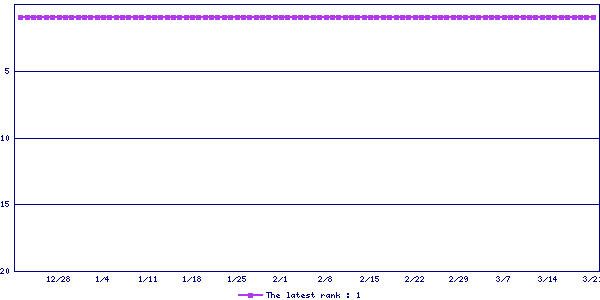
Ranking graph (Updated in 1/3)
Sales ranking graph
The Black Swan: The Impact of the Highly Improbable The Black Swan: The Impact of the Highly Improbable
Nassim Nicholas Taleb Random House(2007-04-17)
$27.00

The Socrates of Wall Street(Rating: 5)
I urge any professional, executive, or manager to study Taleb. He reveals the flaws in how we and our peers think. He has a philosophical approach but has little in commmon with most academic philosophers. He draws from his experience in financial derivatives trading, but has little in common with most investment bank analysts or economists. Instead, like Socrates, Taleb shows how supposed "experts" systematically delude themselves and their audiences into believing they know much more than they really do.

Simply Outstanding Book(Rating: 5)
This (and its sister book 'Fooled by Randomness') completely blew me away. I am a 24 year old finance major, now working as a management consultant, with a real interest in markets and psychology.

The central thesis of the books are tantalisingly simple: the world is so functionally complex (and growing ever more so) that most social phenomena are effectively `random'. Randomness, however, is poorly understood and even more poorly explained by orthodox mathematical modelling which systematically underestimates the `wild randomness' inherent in the world. Taleb suggests (and attempts to demonstrate) that merely understanding the deficiencies of orthodox thinking with regard to randomness (and probability) is a big advantage in life.

The book(s) are a must read for people looking to understand more deeply the world we live in and the limitations with mainstream thought generally and modern portfolio theory more specifically.
I cannot recommend these books highly enough. I read them both in a couple of days and have found them totally absorbing (in a way few books truly are). They challenge and confront and pull the reader out of his or her `comfort zone' with regard to many perspectives on the world. The core readership of the book will obviously be those interested in behavioural finance but I would happily (and will probably) give the books as presents to friends who hate finance. I will probably also give the books to my mother, which for me is the test of whether I consider a book a `must'.

Having said that the author (this is perhaps at times a symptom of his unique writing style) does at times become rather grandiose. He suggests not advising others about how to behave and then only a few pages later commits the very sin he has just warned against. In `Fooled by Randomness' he invents fictional characters "Nero Tulip" (hmm could the initials N.T also stand for someone else?) - the brilliant but modestly profitable trader (that due to massive risk aversion only invests in treasuries) who overcomes cancer but is overshadowed by a flashy superstar trader neighbour who later `blows up'. In `The Black Swan' Taleb later details how he has overcome cancer and is very risk averse, investing a large percentage of his worth in treasuries. This grandiosity is however in the end totally forgivable due to the ability of the anecdotes to entertain and inform the reader.

One other thing that I found slightly difficult to follow (admittedly I am convinced that I am not as smart as the author so it may be my fault) is the fact that in `Fooled' he correctly discusses peoples' inability to think in terms of conventional probabilities and then sharply criticises those `experts' who rely on such probabilities in managing financial risk (a theme built on very powerfully and convincingly in `Black Swan'). There is the risk that (without meditating somewhat and trying to assimilate everything) the reader will be left nodding at everything Taleb says, but later wondering how it all fits together.

Finally, coming from a legal background I found the discussion in `Fooled' about the warped use of probabilities in the OJ Simpson trial very interesting. The author discusses the legal burden as being `beyond a shadow of a doubt'. I am from Australia (with a different legal system to the USA) but this seems a mistake. I would have thought the correct criminal legal burden would be `beyond reasonable doubt'. This is nitpicking I know.

Great book(s). Priceless wisdom and insight.

Against the Gaussians; For the Mandelbrotians(Rating: 4)
N.M. Taleb fulminates against the adepts of the Gauss-distributions (calling them madmen) and applauds profusely the Mandelbrot-fractals supporters. Why? Because the tail-ends of the Gauss-distribution underestimate the occurrence of black swans (unattended phenomena, spikes, large deviations). Indeed, for N.M. Taleb, `our world is dominated by the extreme, the unknown and the very improbable. Our future will be increasingly less predictable because of the apparition of black swans.'
The author even rejects Heisenberg's uncertainty principle, because it is ... Gaussian.

But, as J. von Neumann said: `mathematical formulation necessarily represents only a theory of some phase (aspects) of reality, and not reality itself.' Even Mandelbrot fractals are models. More, its exponents are not easy to gauge.
There is also a huge difference between descriptive and predictive (based on the past) models. Moreover, as the author states himself: `you can project the behavior of a physical system in the future. But we hit a stumbling block when humans are involved, if you consider them living beings endowed with free will.'
However, as Schopenhauer said, our minds did not develop in the first place for thinking, but in order to have the best survival reaction (fight or flight) in case of danger.

I agree with the author that `we just don't know how much information there is in the past'; that `there is a huge gap between what we know and what we think we know' and that `people don't know what they don't know.'

Nevertheless, there are black swans for outsiders which are simply white ones for insiders. For the author, one example of a black swan is the 9-11 massacre. But some people made a killing in the stock market by buying massively put options on airline and brokerage stocks just before the attacks. An extremely strange and mind-boggling event.
There are other black-white swans (see Gene C. Marcial's `Secrets of the Street').

This thought provoking book is a very worth-while read, but it has to be handled with caution.

Tantalising and frustrating.(Rating: 3)
The major ideas in this book are without question very important but unfortunately,in my view, poorly elucidated.The arguments are presented in a rambling confused way with lots of superfluous material that serves to obfuscate rather than clarify. The author seems unable to make a point clearly and succinctly and then leave it alone. The interminable stories, name dropping and confusing exemplars make reading large sections of the book sheer drudgery. In addition by basically calling everyone who disagrees with him a moron he casts himself in a very poor light.I also suspect that English is not Mr Talebs native language and this explains his awkward somewhat stilted prose. At the end of the book I could not help but feel that an opportunity for a great book had been squandered for want of a good editor.

Extreme annoyance(Rating: 1)
This is one of the most annoying books I have ever tried to read. Perhaps this is because I have a Ph.D. in economics and know something about the topics covered, but could also be because Taleb has a self-indulgent, self-referential, inchoate writing style that would drive any discerning reader crazy. His arguments are almost always tendentious, his expositions seriously flawed, his conclusions spurious. You will learn little or nothing from this book, and may find the experience of reading it highly annoying.


List of the stable sellers more than 1 month


This site is updated several times automatically in every day.
If you have any requests, please send an e-mail to info-us@categola.net . 2007 - 2008 Categola.