Logo

Categola

Selected links and good sales products in net shop
Google News
(For United States, Canada, United Kingdom, Japan)
Related Pages :   Baseball  / List of the stable sellers more than 1 month

Baseball : Stable Sellers more than 1 month

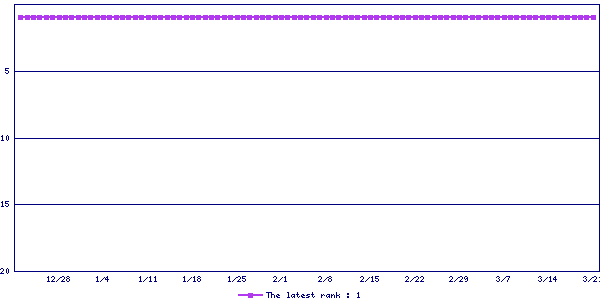
Ranking graph (Updated in 3/13)
Sales ranking graph
Moneyball: The Art of Winning an Unfair Game Moneyball: The Art of Winning an Unfair Game
Michael Lewis W. W. Norton & Company(2004-04)
$13.95


Charlie Finley was the First Practitioner of "Moneyball"(Rating: 5)
This book burst on the scene in 2003 to spark an intense debate about how and why some Major League Baseball teams succeed and others seem hapless in their efforts to build a winning franchise. Using as his model the Oakland A's, author Michael Lewis emphasizes the efforts of General Manager Billy Beane to use sophisticated statistical models to draft, trade for, and employ talent on a tight budget. This approach asserts that baseball is a business and that the conventional wisdom of how to create a successful MLB franchise is incorrect for teams without extensive monetary resources. At the time Lewis was writing, of course, the A's were an exceptionally successful team, making the playoffs each year between 2000 and 2003, and again in 2006, with one of the lowest payrolls in MLB. The message of "Moneyball" was clear: the old adage that large market teams would dominate was outmoded--read the New York Yankees as the poster child for large market teams and the Kansas City Royals as the poster child for small market franchises--and the A's broke the mold.

Of course, the "Moneyball" approach of cagey signings, clever trades, and strategic dumping of established stars for handfuls of prospects became the cause célèbre of MLB management in the middle part of the decade just passed. It all seemed so new and remarkable. Indeed, the fact that a number of small market teams won the World Series between 2001 and 2009 suggested this approach might have salience. After all, during that period the small market Diamondbacks (2001), Marlins (2003), and Cardinals (2006) won the World Series. But then so did the Angels (2002), Red Sox (2004 and 2007), White Sox (2005), Phillies (2008), and Yankees (2009), certainly not small market teams.

No question Michael Lewis pinpointed an important trend in the strategic processes of building winning MLB teams. "Moneyball" has received considerable discussion, appropriately so, but was what Lewis describes all that new? Let me suggest that much of what "Moneyball" documented had been pioneered nearly three decades earlier by Charlie Finley, owner of the Oakland A's, who with the rise of free agency in the 1970s sold and traded his star players to restock his farm system with excellent prospects. While the A's won three straight World Series between 1972 and 1974, his team collapsed as he sold off or saw players leave through free agency thereafter. Then by 1980 he was back with a new crop of players just off the farm, the great of them was Rickey Henderson.

Charlie Finley probably deserves some credit for pioneering the "moneyball" approach of small market teams in putting winners on the field in the 1970s. Like the later celebrated A's management, Finley scouted, signed, and developed young talent that can then compete successfully against richer competitors. Using the rules of player compensation established in MLB, he grew young superstars and pay them only modestly until the players' seniority in the system allowed them to depart as free agents. Before their departure, however, he often dealt them for top prospects to restock their farm system. Absent the emphasis on ornate statistical analysis undertaken in the more recent "moneyball" era, Charlie Finley was the godfather of this approach to running his franchise as free agency became the norm. He deserves credit for pioneering this approach.

"Moneyball" is a fascinating book; a benchmark in the study of history of MLB as a business. Enjoy!

MONEYBALL - Great book!(Rating: 5)
MONEYBALL is a great book. Michael Lewis is a writer who knows how to keep the reader moving through the book. There is a lot of detail in this text and it is written with excitement that keeps you flipping the pages. There is a constant sense of, "What is going to happen next?" or "Why did they do that?" and Lewis is able to present already interesting information in an even more interesting format that keeps your eyes glued to the page: "All he saw was that one major league baseball team treated him like a used carpet in a Moroccan garage sale..." When you have language such as this, coupled with information as to how an under-bankrolled baseball team produces winning records, you have one awesome book.

Statistical information proves that numbers are better at determining what is successful than what the eye can see. Purchase this book if you want to learn a few things and, simultaneously, be entertained in the process.

Paradigm Shift For Baseball(Rating: 5)
In the early 1990s Billy Beane, the GM of the Oakland A's, combined Bill James statistical data for baseball junkies, hired Harvard graduates and brought the power of technology to baseball.

Neccessity is the mother to invention. The Oakland A's ownership did not have the money to compete for players in a league with no salary caps. And he figured out a way to build a competitive baseball team using statistical analysis.

Up to that point, baseball relied on having 100s of scouts watch players and rate them numerically with KPI's like hitting, hitting for power, speed, arm stregth and fielding ability. The rating's input was only as good as the amount of times the scout saw the the High School or College player. And the ratings were subjective, unique to each scout, so there was no way to compare ALL scouted players. Scouting main objective was to provide a GM input in the amateur draft.

Beene did not have the money to employ enough scouts to cover the country. So he decided to only draft college players as opposed to HS players because the former had a rich and accurate database of statistics.

It is more complicated than this - but Beene believed that the most important hitting skill was "on base percentage". So he drafted players in each round based on this object number

He went on to use Harvard graduates to refine the objective number. One iteresting refinement was actually divided each ball park into a gride using thousands and thousands of rows and columns. By doing this he deducted hits that an average fielder should have made an out and added hits that an exeptional fielder denied a hit.

His concepts now are widely used. So much in fact that the "playing field" has been leveled and the richer teams now again have the advantage.

Michael Lewis is a great writer. His other books have all been successful. The latest of which was called "Blind Side" that was made into a movie and Sandra Bullock just one a Golden Globe for here performance in the movie.

6 years later, still a wonderful read(Rating: 5)
I hate watching baseball. I was so glad when my kids stopped playing. So I was surprised to find this book so riveting. It is a masterpiece of non-fiction writing. Billy Beane would be a great character to play, although the role needs someone like a young George Clooney, rather than Brad Pitt. The fact that Billy Beane claimed to be the best athlete in the A's workout room says it all.

Great Business Book Disguised as a Baseball Story(Rating: 4)
The book is an easy and very interesting read. Michael Lewis is a great writer. Although he is writing about a topic I have little interest in (baseball) I was still drawn into the characters of the story and the business lessons the story offered.


List of the stable sellers more than 1 month


This site is updated several times automatically in every day.
If you have any requests, please send an e-mail to info-us@categola.net . 2010 Categola.