Logo

Categola

Selected links and good sales products in net shop
Google News
(For Canada, United States, United Kingdom, Japan)
Related Pages :   Computers and Internet  /  Hardware  /  Software  / List of the stable sellers more than 1 month

Computers & Internet : Stable Sellers more than 1 month

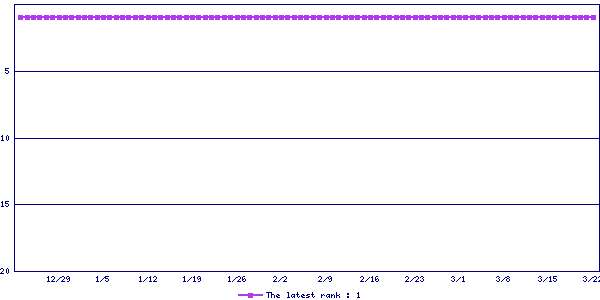
Ranking graph (Updated in 8/29)
Sales ranking graph
The Black Swan: Second Edition: The Impact of the Highly Improbable: With a new section: "On Robustness and Fragility" The Black Swan: Second Edition: The Impact of the Highly Improbable: With a new section: "On Robustness and Fragility"
Nassim Nicholas Taleb Random House Trade Paperbacks(2010-05-11)
CDN$ 20.00


Great read(Rating: 5)
This is a great book to read as it helps expand the context in which you view historical events and market movements. This book is not designed to show you the ins and outs of the market. I beleive this book is helpful in looking at your portfolio critically and to plan for events that may not fall within the parameters of your model. This is not a book that requires a PhD to read and find relevent, just a healthy interest in self development and education of ones flaws. An open mind is required when reading a book such as this that forces one to question the very fabric of what they deem to be reality.

A masterpiece! Why all the negative reviews?(Rating: 5)
I found this book a breath of fresh air. We tend to read in an echo chamber of books that confirm our world view. Black Swan is not like this. Telab dismantles our inbuilt pretensions and invites us to live with the mystery of not knowing jack all about the world, the future and knowledge in general. This book is a treasure trove of caustic wit and sharp intelligent insights; from the problem of induction (but in the real world), to the phoney Nobel laureate scam jobs, pseudo geniuses selling mumbo jumbo and other economic modelling idiocies and philosophical paradoxes that have never occurred to me before. Thus this book really got my mind racing. Taleb is a very clever man for sure and he lets us know it. He believes himself to have made great discoveries concerning the stupidity of the bellied up beast we call capitalism and why things generally tend to cock up in unexpected ways. Oh, and he shows why experts don't know as much as you and I, which I find very worrying! Thus this book is well worth the read, just to swim inside the mind of a true intellectual. And not one of those pop intellectuals who grave our culture (and populate the philosophy book shelves at my local Waterstones)! Taleb then is on hand to tell you how it is. He has experience working in the `machine', he's made lots of money and so he's in a good position to insult the map and kick the territory; which he does with venom. He has plenty of funny venomous asides aimed at philosophers and `experts'.

Though I'm not qualified (or clever enough) to comment on the guys massive ego (it really is huge!), he just puts his ideas out in a crystal clear and provocative way which I find irresistible. He writes with confidence you see and so he seems to know what he is talking about. So if you can stomach the man's genius complex, you may well start finding him a charming and somewhat very funny character (as I did). What Taleb has to say he says it really well and so his book is a joy to read and well worth your time. Though it can be challenging in places (you won't finish it in one sitting), you will put it down and so that you can process what you have just read.

I'm therefore bemused by all the negative reviews for this book. Ok, for sure, Taleb does ramble on a bit and he struggles with his punch-lines (get to the point man!) but, I reckon anyway, clever people should be allowed to ramble with impunity, as long as their position is strong and they have something to say. So if you're smart, ignore all the negative winging and whining about Talebs arrogance. God, these days you can buy a book for the price of a Big Mac (I bought this one for $2) and Black Swan is a very digestible read indeed. So just give this book go and stop moaning that Taleb needs an editor and digest the man's ideas instead.

A great book by a somewhat arrogant writer...(Rating: 5)
Let me begin this review by noting that Nassim Taleb is the type of author who evokes strong responses in most individuals. You either love his work or hate it. What I find interesting is that the response tells us far more about ourselves than about Taleb's books.

It is easy to understand why The Black Swan is such a huge best seller. The book is written in a very engaging style and includes very interesting narratives that are full of powerful images and interesting subjects. Taleb writes about such topics as scalability, confirmation errors, epistemic arrogance, the ludic fallacy, Mandelbrodtian randomess, Extremistan, Mediocristan, the fallacy of silent evidence, narrative fallacies, Platonic folds, randomness and (as) incomplete information, future blindness, etc.

Taleb points out to his readers that the world is a far different type of place than they imagine it to be. To this end, Taleb brings out two Weberian Ideal Types: Mediocristan and Extremistan. They are 'utopian' places that are defined by the idea of 'non-scalability' or 'scalability.' Taleb points out that we have non-scalability when the consequences of an action or activity are dependent on the efforts that are used. He notes that the compensation of a Doctor, Lawyer, or call girl is not scalable because it depends on the time available to the individual providing the service. On the other hand, a painter, composer, or author can produce returns that are unconnected to the quantity of effort. A Picasso sketch can sell for a few million dollars even though the artist may have taken a few minutes to create it. But the work of another painter who took months to complete it may not sell for $50. The art world does not care how much time went into producing a work because its value has little to do with the labour or materials that went into producing it.

In Mediocristan, nothing is scalable. Output and rewards are constrained by time, boundary conditions, and other factors too numerous to mention. It is a place which is dominated by random variation and can be adequately described by Gaussian probability models. In such a well ordered world no single value can have a large affect on the distribution that we are looking at. If we are looking at the average weight, height, or hat size of an adult, an extreme outlier will not have a material effect on our result. Think of a sample of 1,000 randomly selected adults that gets a sumo wrestler being selected as the 1001st addition. The fact that the sumo wrestler is much heavier than average will not be meaningful to the calculated mean.

Things are very different in Extremistan where variations within distributions are not as constrained. It is the place where scalability dominates and actions produce distributions that can frequently have extreme values. Those extreme values will often affect the total of attribute values and the mean in a sample distribution. In that world the probability of observing extreme events is much greater than what is seen in the typical Gaussian models that are adequate for describing Mediocristan. While it is easy to use to use Gassian distributions to describe adult weight, height, hat size, mortality rates, etc., they cannot be used to describe distributions of income, wealth, film sales, etc.

Taleb points out that we live in both worlds but try to apply the distribution models of Mediocristan to try to predict what happens in Extremistan. In our weight example we saw that the addition of a sumo wrestler did little to our mean and distribution. That is a perfect example of how Mediocristan works. But if we change that to wealth and add a Bill Gates or Warren Buffett as our next data point to our sample we see that both the mean and distribution change significantly because either man has more than a million times the wealth of our 'average' individual. That is what makes Extremistan so different.

The problem arises when individuals try to use a model of Mediocristan to describe the social and economic spheres, where the models are not applicable and have never been applicable in a human society. In modern human societies power law distributions are dominant in the social sphere so it is not usual to see most of the income, wealth, and power be concentrated in the hands of a few. It does not matter if the society is socialist, fascist, democratic, or a limited government republic.

Most harm is done when people and professional forecasters, who know far less than they think that they do, are fooled by randomness and use the wrong probability models to predict outcomes. The problem is that most of the people who are considered 'experts' cannot deal with the real world distributions in the social sphere and wind up making assumptions that are only suitable for the physical world. They come up with all kinds of models that bring them undeserved fame and prestige. As Taleb points out, most of the Economics Nobel Prizes have gone to idiots who got the story wrong and came up with models that do much more harm than good. And this is where Taleb crosses the line and angers many readers who do not want to hear his message. Most people are comfortable with the way things are and do not want to see their cherished myths exposed by a rational review of the facts. They are particularly angered when Taleb makes it clear that he is well aware of his considerable intellect and that he is much smarter than his average reader. That arrogance does not play well with many readers and more than a few are likely to rate his book poorly even though it is one of the best books that one could hope to read on the subjects that are covered in its pages.

My advice is to look into the mirror and figure out what kind of person you are before you buy the book. If you don't have the time or energy to read the book carefully, or like your view of the world as it is and do not wish it to be challenged then stay away. But if you have an open mind, like to have your views challenged, have no problem working through a few difficult passages that may require you to do some additional reading, and love well written material by an author who brings knowledge of many subjects, than this book is for you. Good luck. I hope that you make the right decision.

At times interesting, but ultimately empty of new ideas(Rating: 1)
The author is clearly a well read, well traveled and well connected individual (and he makes sure you know it!). As a result, the book is at times quite interesting since the book consists largely of him recounting his experiences.

However, the core premise of the book is that the current statistical models, used to predict the (future) value of financial instruments, are invalid, and should not be used, and instead, his Mandelbrot methods should be used instead. Having made such a claim, he should back it up with firm evidence. But he never does. Instead he talks about guessing exponents to be used in creating his models. Guessing?!? How is this a step forward? Moreover, even if he is onto something, he never really lets the reader in on how one goes about using this method or even provides good references.

So in the end, the book leaves the reader with the empty feeling that he just wasted many hours reading a book that leads to nowhere. I think his ideas will be forgotten.

Save your money(Rating: 1)
Unless you are masochistic and enjoy the pompous attitude and the often crude insults of the author, pass on this book.

The useful content of this book could be summarized in a page.


List of the stable sellers more than 1 month


The stable sellers in recent
8/15 Strengthsfinder 2.0: A New and Upgraded Edition Of the Online Test From Gallup's Now, Discover Your Strengths Strengthsfinder 2.0: A New and Upgraded Edition Of the Online Test From Gallup's Now, Discover Your Strengths
Tom Rath Gallup Press(2007-02-25)
CDN$ 30.50
Average Customer Review: 3.5 (5 customer reviews)
["Mirror, mirror on the wall...."]


This site is updated several times automatically in every day.
If you have any requests, please send an e-mail to info-ca@categola.net . 2010 Categola.